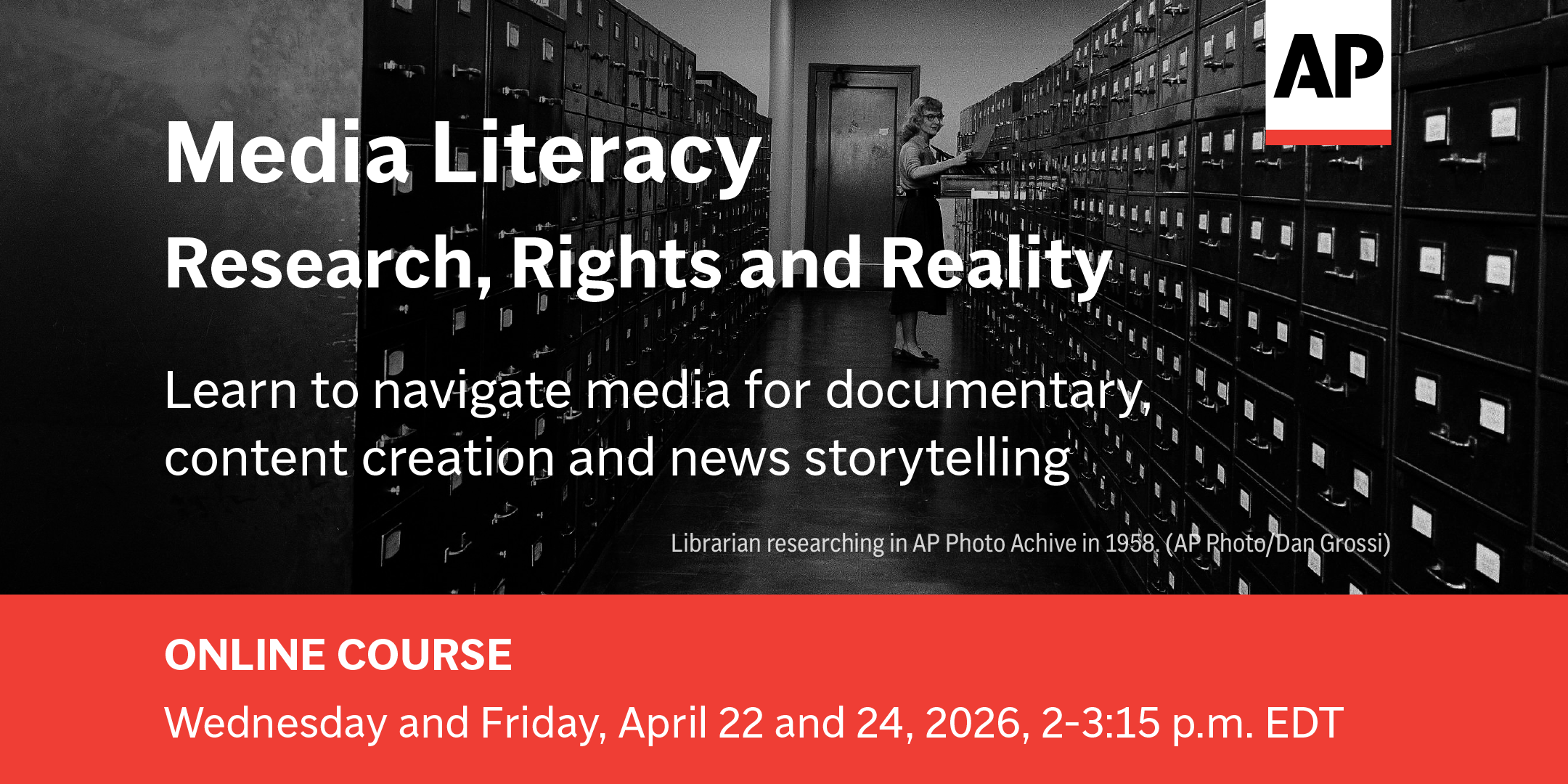
A two-part online course on Wednesday and Friday, April 22 and 24, 2-3:15 p.m. EDT.
 |
If you’re developing a documentary, investigative story or historical project, this course offers a clear overview of the essential tools, practices and considerations. You’ll learn how to research archival material and apply core journalistic investigative practices, and you’ll gain an understanding of why primary sourcing is the gold standard. This course will present key legal considerations around fair use and copyright and will teach you best practices for verifying sources to avoid deepfakes, misinformation and other credibility risks.
Online classroom includes:
Access to live guest speaker sessions
Recordings of live sessions
Resources for people just getting started with media research
Discussion groups for peer support and connection
Live sessions run on Wednesday and Friday, April 22 and 24. You can join live or watch recordings at your convenience.
For course support, contact ap@edmaker.co.
Register now! Tickets are $149.
Program
|
Part 1: Research and investigative fact-checking
Wednesday, April 22, 2-3:15 p.m. EDT
Develop skills in surfacing archival material from primary and secondary sources.
Session 1: Introduction to media archives and their importance
This session will cover:
Differences between historical, biographical, investigative, true crime and narrative documentaries
Working with directors and editors to source archive imagery to enhance storytelling
Where and how to access archival materials audio, photography and footage (digital and physical)
Types of libraries and collections — university special collections, museum holdings, government records, historical societies, news archives, wire services, image collections
Ethical considerations if using generative AI
We’ll share a case study of a produced documentary with examples of hard-to-locate materials.
Speaker
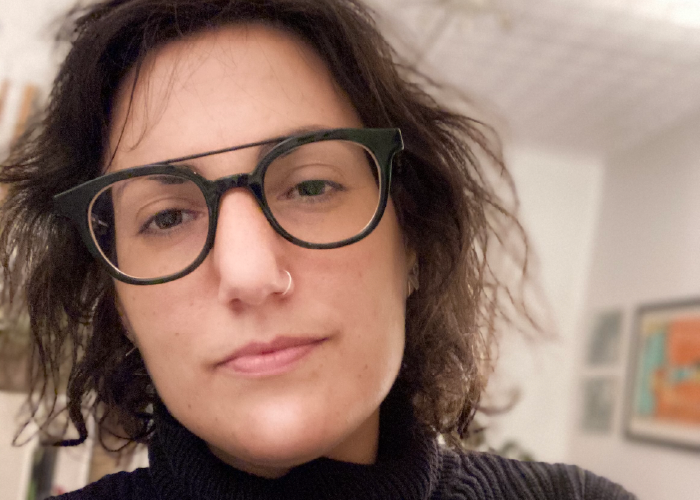
Lindsey Schneider, archival producer
Lindsey Schneider is an archival producer with almost 20 years of experience on investigative, biographical and historical documentary films. She has worked on projects that have won every journalism award, multiple Emmys and an Oscar for best feature documentary. From the rise of the Islamic State to police violence to Russia's invasion of Ukraine, the projects that she has worked on focus on social justice issues, extremist politics, government corruption and often-controversial subjects. Alongside investigative reporters, she specializes in finding audiovisual evidence to show the rarely seen sides of our society and culture to reveal dark truths. Her long-form documentaries have been broadcast on major networks and streaming services, including HBO. Showtime, Netflix, PBS, VICE and Sky.
Session 2: Best practices for digital asset management
Learn tips and best practices for pre-production research and understand the pitfalls of searching online. The session will cover:
What is Digital Asset Management practice: metadata, taxonomy, sourcing
Why Digital Asset Management matters in an AI landscape
How to use it for library research
How to organize and track assets for production (audio, photo, footage, ephemera) and understand formats
Speaker
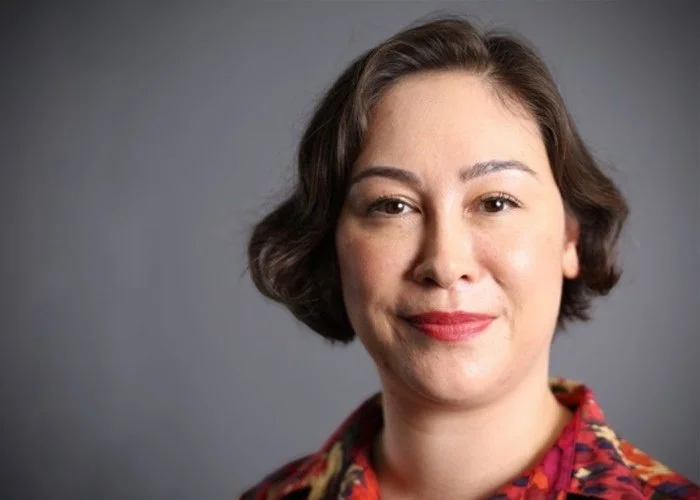
Lucy Smee, research manager, AP Archive, The Associated Press
Lucy Smee is a trained film archivist who has worked on projects around metadata creation, digitization and user access in several UK media archives, including BBC, Wellcome Library, BFI National Archive and Amnesty International. She has been the research manager for AP’s audiovisual archives for more than ten years. During her time at the AP, she was voted Best Archive Footage Employee by FOCAL members. She holds a B.A. in American Studies, M.A. in Film Studies with Film Archiving and M.A. in Digital Asset and Media Management.
Session 3: Records Act Requests and Strategy
After reviewing the basics of public records act requests, this workshop introduces an array of advanced – but easily replicable -- approaches to structuring requests and negotiating when an agency resists release.
Speaker
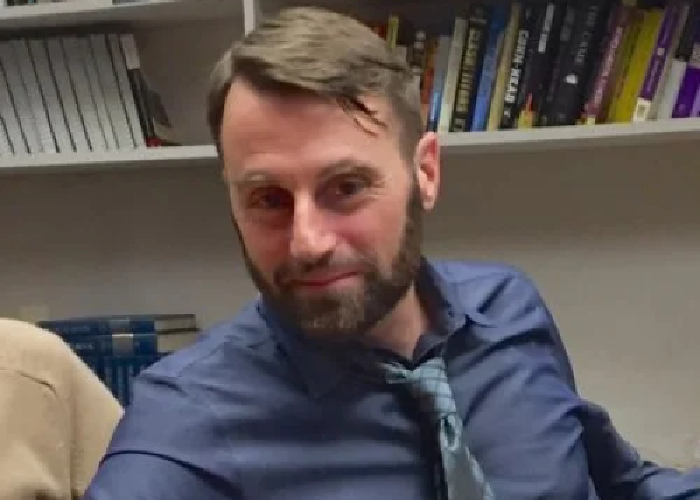
Justin Pritchard, investigative editor and reporter The Associated Press
Justin Pritchard is an editor and reporter on AP’s Global Investigations team. His work has changed law and policy across a range of areas.
Part 2: Rights and reality: Fair use, copyright and AI
Friday, April 24, 2-3:15 p.m. EDT
Understand your rights and responsibilities around surfacing and using media in documentaries, narrative films, commercial projects and other media presentations to avoid legal pitfalls. The session will explore how to research through public news sources versus privately owned content, and the copyright implications of each. It will also cover how AI is changing perceptions of historical documentation.
Session 1: Overview of copyright law as it applies to media
We’ll break down the differences between fair use and public domain and will explain how to understand Creative Commons licenses. The session includes examples of copyright infringement versus strong fair uses, as well as providing a framework for understanding fair use factors and applying them to your creative projects.
Overview of copyright law as it applies to media
Breaking down the differences of fair use and public domain
How to understand Creative Commons
Speaker
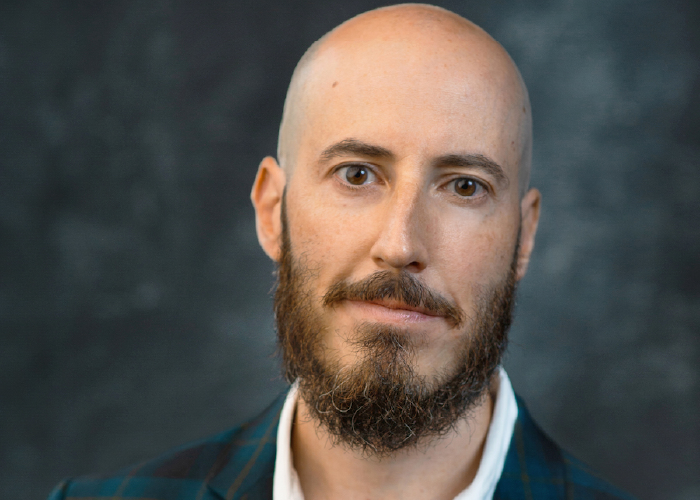
Ian Rosenberg, VP and associate general counsel, The Associated Press
Ian Rosenberg is vice president and associate general counsel for news, litigation and intellectual property at The Associated Press. He is a media lawyer with over 25 years of experience specializing in First Amendment, libel and intellectual property law. Ian is also an adjunct associate professor at Brooklyn College. Previously he was the general counsel of Latchkey Films, an acclaimed documentary production company, an assistant chief counsel advising ABC News and an Emmy-nominated documentary filmmaker. He is the author of “The Fight for Free Speech: Ten Cases That Define Our First Amendment Freedoms,” the nonfiction graphic novel “Free Speech Handbook” (art by Mike Cavallaro) and the forthcoming “Terrible Stuff Damaging Everybody: The True Story of Lies and Libel in Dominion v. Fox” (NYU Press, September 2026).
Session 2: Deepfakes and AI
This session will cover how to detect manipulated or AI-generated photos and videos and how to use verification tools to do basic image forensics. We’ll share a case study of historical fact-checking with AI.
Manipulated media: understanding intent (if it’s too good to be true, it probably is)
Spotting edited or AI-generated photos and videos
Verification tool
AI and hallucinations
Speaker
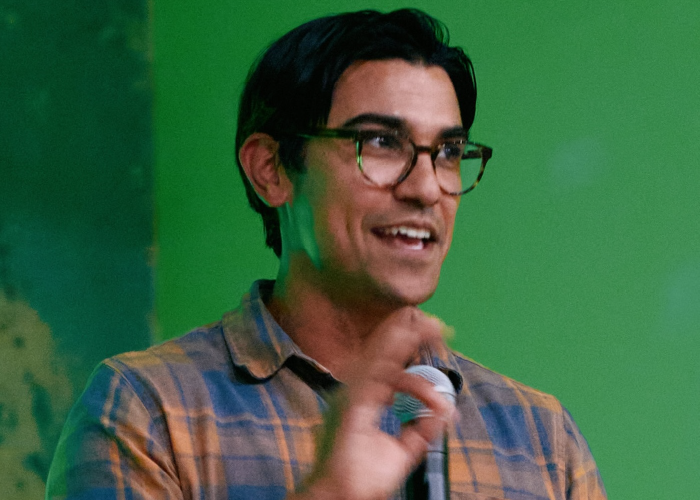
Alex Mahadevan, director of MediaWise
Alex Mahadevan is the director of MediaWise, a digital media literacy initiative based at Poynter, where he's also on faculty leading AI initiatives. He's trained thousands of students, older adults and journalists in online verification, digital and AI tools and media literacy. Alex co-wrote Poynter’s AI ethics guide, led its two summits on AI, Ethics and Journalism and co-leads Stanford's Empowering Diverse Digital Citizens Lab. He began his career as a reporter, editor, videographer and data journalist at Observer Media Group.
Session 3: An inside look into AP news video production
This session will cover how to quickly assess user-generated content for breaking news stories.
Using third party content and UGC in storytelling: opportunities and risks
Cross-referencing and triangulation methods to fact-check sources
Understanding verification best practices related to AI in news development
Vetting third party sourced materials
We’ll share a case study of a hard-to-clear breaking news story.
Speaker
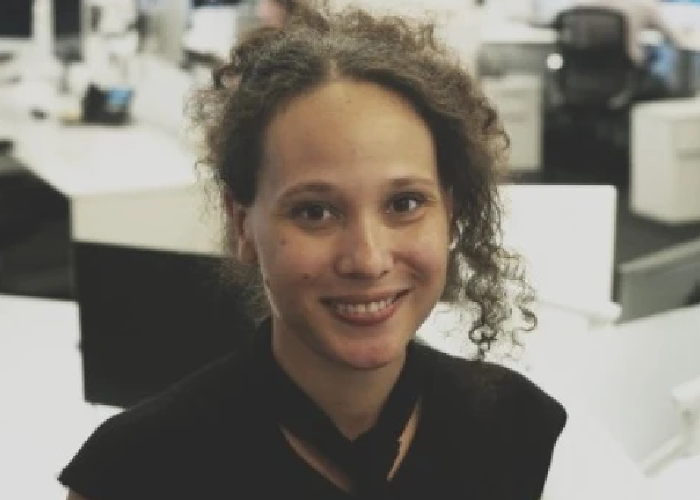
Beatrice Dupuy, AP producer UGC video, The Associated Press
Beatrice Dupuy is a newsgathering producer based in New York for The Associated Press. She specializes in breaking news reporting and verifying video.